
The Truth About Losing Postpartum Belly Fat
Written by Dr. Lizzie Kieffer, DPT.
First, let’s just start with talking about the fact that it is okay to have aesthetic goals for your body. There is nothing wrong with wanting to lose belly fat or lose weight in general, in fact, I find that it is a common goal for women, especially for those who are post-pregnancy. So if many of us have aesthetic goals and want to try to rid ourselves of the stubborn belly pooch, then let’s talk about what’s really going on here and determine how to approach this in a safe, effective and healthy way!
Because while body fat can absolutely be part of the picture, it's often not the entire story.
In fact, many women are doing all the things they think they're supposed to do: exercising consistently, walking more, trying to eat healthier, and still feeling frustrated that their abdomen doesn't seem to be changing the way they expected. And part of the problem is that we tend to lump every postpartum abdominal change into one category: belly fat.
But your abdomen is influenced by much more than body fat alone: muscle mass, deep core function, pressure management, rib positioning, posture, and diastasis recti can all affect how your stomach looks, feels, and functions after pregnancy.
So if your goal is body recomposition or to change the appearance of your midsection, it's important to understand which pieces of the puzzle are actually contributing to what you're seeing. Because while nutrition plays a major role in reducing body fat, strength training, protein intake, cardiovascular exercise, and deep core function all play important roles too!
first, let’s talk about body fat in general
If your goal is reducing body fat, nutrition is typically the biggest driver.
This is often where women get frustrated, because they assume that if they're exercising consistently, the body fat should automatically disappear. While exercise is incredibly important, body fat reduction is largely driven by nutrition and your overall energy balance.
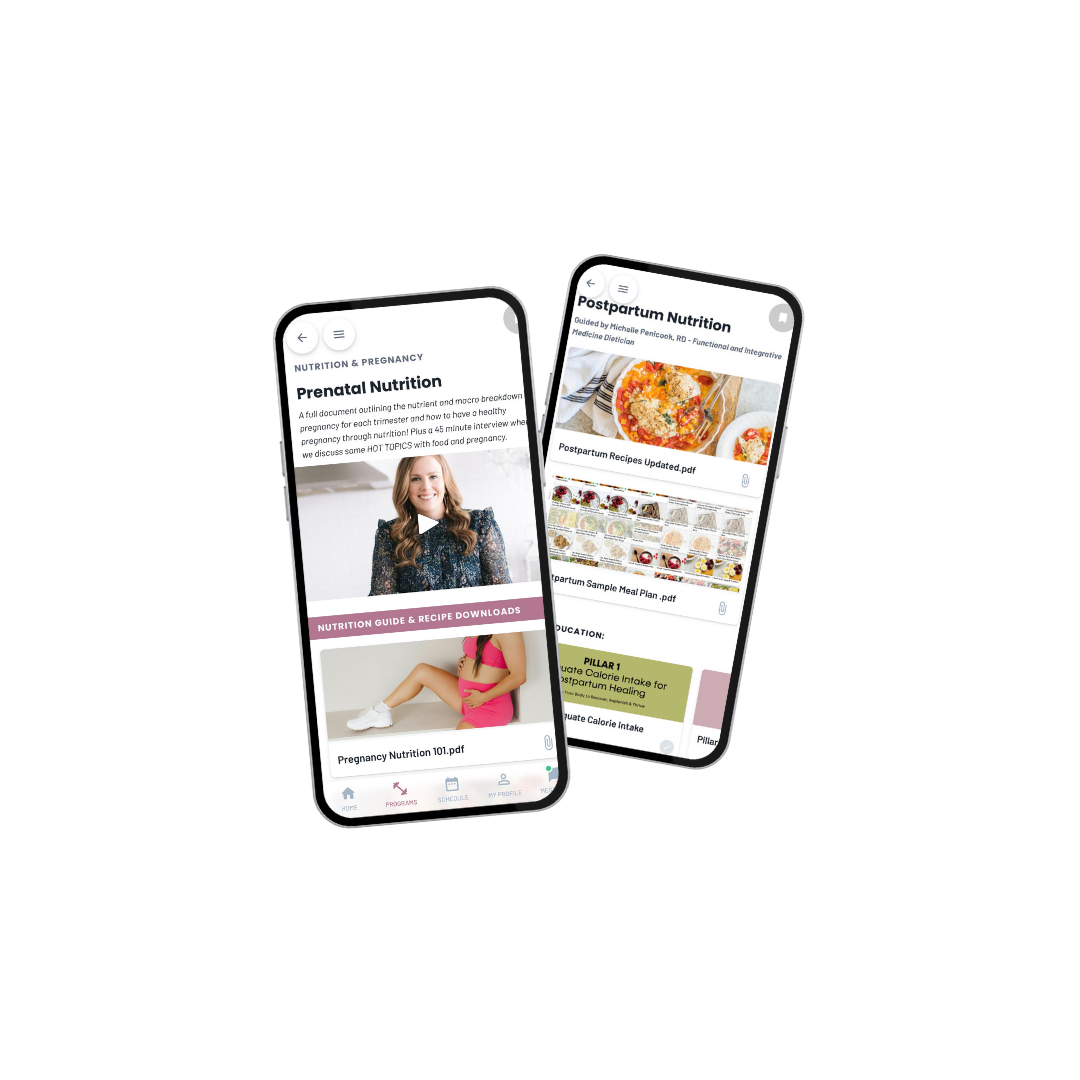
This is also why nutrition is a piece that’s included in Mind Body Core…because it’s that important! I made sure to bring in the experts (Michelle Penicook, RD - Functional and Integrative Medicine Dietician) and include full prenatal, postpartum and general women’s health nutrition programs inside the app and available for you to use at any time depending on the specific season of life you’re currently in. From meal plans to recipes to educational modules, it truly has it all broken down in a way that makes it easy, accessible and practical for you to implement into your daily life!
But in simple terms, fat loss occurs when your body consistently uses more energy than it takes in. That doesn't mean you need to slash calories, eliminate entire food groups, or follow an extreme diet. In fact, those approaches are often the hardest to sustain long-term.
Instead, the focus should be on building nutrition habits you can actually maintain. Things like:
Eating enough protein
Being mindful of overall calorie intake
Prioritizing nutrient-dense foods most of the time
Staying consistent with your choices over weeks and months, not just days
The women who see the best long-term results are rarely the ones following the most restrictive plan. They're usually the ones who find a sustainable approach they can repeat over and over again. One of my favorite ways to help explain this is → Strength training builds muscle. Nutrition helps reveal it.
Both matter, but if body fat reduction is your goal, nutrition deserves a seat at the table!
why strength training still matters
So, if we know that nutrition is one of the biggest drivers of fat loss, then do we even need to worry about strength training or other activities? Well, actually yes!
While nutrition helps create the conditions for fat loss, strength training helps determine what happens to your body composition during that process. When women lose weight through diet alone, they don't just lose body fat. They often lose muscle mass too. And that's a huge problem (especially for women) because muscle plays an important role in strength, metabolism, function, and long-term health.
Research shows that combining resistance training with nutrition interventions helps preserve lean muscle mass while promoting fat loss. In other words, strength training helps your body hold onto the muscle you've worked hard to build while you're losing body fat! This is one of the reasons I encourage women to prioritize strength training throughout pregnancy, postpartum, and beyond. The goal isn't simply to weigh less…we don’t believe in shrinking ourselves over here. No, the goal is to build a stronger, more resilient body!
Here are a few major things that strength training helps with:
Preserve muscle mass during fat loss
Improve overall body composition
Support metabolic health
Increase strength and function for daily life
Support long-term health and longevity
Because at the end of the day, the number on the scale only tells part of the story. A woman who loses 10 pounds while maintaining her muscle mass will often look, feel, and function very differently than a woman who loses 10 pounds while also losing significant muscle. So rather than focusing solely on losing weight, focus on maintaining and building muscle while reducing body fat! That's where many of the long-term changes women are looking for actually happen.
don’t forget about protein
Protein. We are inundated with “high protein” this and “protein packed” that. High protein has become somewhat of a trendy health thing, but do you know the why behind it? And what does eating more protein have to do with fat loss?
Research consistently shows that higher protein intake helps preserve muscle mass during fat loss and supports strength gains when paired with resistance training. This becomes especially important if you're trying to reduce body fat because, as we discussed above, the goal isn't just to lose weight. The goal is to maintain as much lean muscle as possible while doing it. Also, for a little nerd tidbit, did you know that it takes more energy for our body to digest protein than any other macronutrient? Which is another reason why a high protein diet can help to support a weight loss goal.
Overall, this is the role that protein plays in this process:
Helps maintain lean muscle mass
Supports muscle recovery after workouts
Helps keep you fuller for longer
Supports overall body composition goals
Think of protein as the building block your body uses to repair and maintain the muscle you're working so hard to build through strength training. And the truth is, most women just really aren’t eating enough protein in general! And if you think you are (or are not) try tracking it for a few days and see what number you come up with. It might actually surprise you!
If you're strength training regularly but not paying attention to protein intake, it might just be worth a look, because the combination of strength training, adequate protein, and sustainable nutrition habits is truly where the magic of body recomposition starts to happen!
cardio can help too
While strength training is the main feature and foundational aspect of body recomposition, cardio has a place in the conversation too! Research shows that aerobic exercise can help reduce body fat, waist circumference, and overall body weight, especially when performed consistently over time.
And one of the biggest misconception many have (especially after reading something like that), is that they need to now spend all their time doing it. But here’s the good news - you do NOT need to spend hours on the treadmill in order to reap the benefits of cardio!
Simple forms of cardio like:
→ Walking
→ Zone 2 cardio
→ Hiking
→ Cycling
→ Swimming
…can all contribute to your overall health and body composition goals.
Here’s some benefits to cardio:
Increase overall energy expenditure
Improve cardiovascular health
Support fat loss goals
Improve endurance and stamina
Support long-term health
But here’s the catch…it’s all in the way you balance out your activities. It’s easy to start swinging too far into one direction…either spending all your time doing cardio and skipping strength training altogether, or becoming so focused on lifting weights that we stop moving outside of our workouts.
The sweet spot (as always) is usually somewhere in the middle. Think of strength training as the tool that helps build and preserve muscle, while cardio helps support cardiovascular health, daily movement, and overall energy expenditure. And again, the goal isn't to spend hours doing cardio every day. It's to find a sustainable amount that complements your strength training and fits into your life long-term!
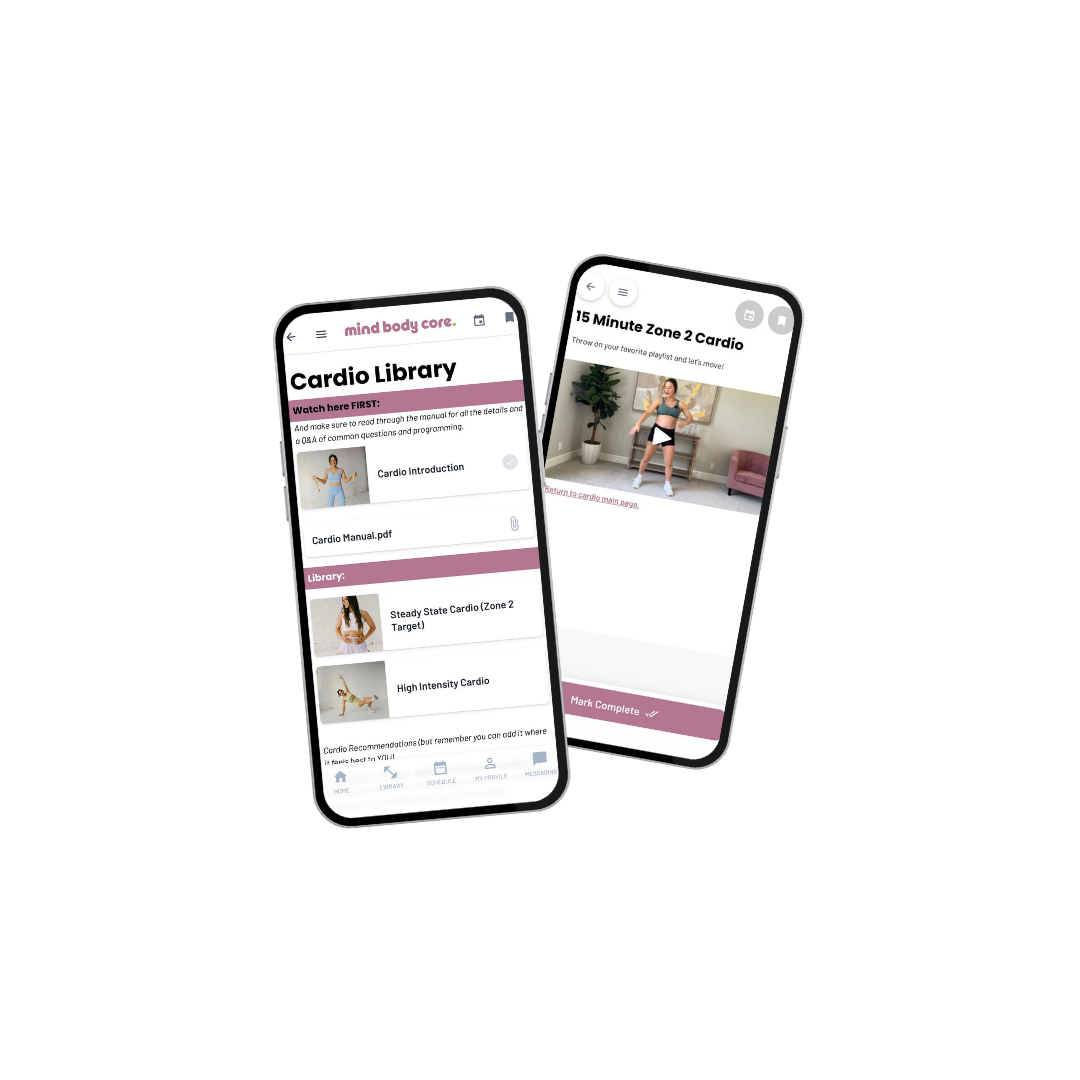
And also remember, you do NOT need to be killing yourself during these cardio sessions! Remember that zone 2 cardio is LOW intensity and has benefits of supporting endurance, fat metabolism, and hormone balance. And the options for zone 2 activities go well beyond the treadmill or running. It doesn’t have to be running at all if you don’t want it to be!
And If you are doing higher-intensity cardio (which is zone 4-5), then the benefits are more like improving your VO2 max and metabolic health. And again, this doesn’t mean all out sprints or treadmill intervals or any of that if that’s not your cup of tea!
I have an entire cardio section inside MBC that explains all of this and provides zone 2 and higher intensity options (that have nothing to do with a treadmill!). If you’re needing some inspiration and a better understanding of the role of cardio, make sure to check it out!
what if it isn’t just body fat?
This is the piece many women never hear about…because sometimes, when you feel like you have this stubborn belly pooch that simply won’t go away, it may not be as simple as belly fat, especially if you are someone who has already been strength training, eating more protein, walking regularly, and making nutrition changes, but still not seeing the results you’re wanting.
In many cases, the appearance of the abdomen, and how “flat” your stomach appears, can also be influenced by:

Diastasis recti
Poor pressure management
Rib flare
Deep core weakness
Poor coordination between the core and pelvic floor
Postural changes
Remember, your abdominal wall is more than just a layer of muscle sitting underneath body fat. It's part of a larger system that includes your diaphragm, deep core, pelvic floor, ribs, and pelvis. And when those pieces aren't working together effectively, it can affect how your abdomen looks, feels, and functions. And second reminder, ALL of these pieces are affected by pregnancy, birth and how you heal postpartum.
So, in an effort to take all of these puzzle pieces that have been laid out in this blog and start to put them together, if you feel like you already ARE doing all of the other things we’ve talked about, but this one area isn’t budging for you, then let me introduce you to the final puzzle piece…hint hint - keep reading!
why deep core training matters
And the final missing piece is…deep core training!
If you’ve been around here for any length of time, you've probably heard me talk about the deep core. A lot. And there's a reason for that!
When we talk about the deep core, we're not just talking about your abs. We're talking about an entire system that includes your diaphragm, pelvic floor, deep abdominal muscles, and the muscles that help stabilize your spine and pelvis. These structures are designed to work together. Every time you breathe, lift your child, carry groceries, exercise, or simply move throughout your day, they're constantly working behind the scenes to create support and manage pressure throughout your body.
When that system isn't functioning well (either from pregnancy, injury, labor/birth experience, postpartum healing or other), you may notice things like:
Difficulty connecting to your core
Rib flare
Abdominal doming or coning
Persistent abdominal protrusion
Pelvic floor symptoms
Feeling weak or unsupported through your midsection
…just to name a few. And this is why deep core training isn't just about getting a flatter stomach! It's about improving the way your body functions…because it’s very likely that if you’ve noticed a lower stomach pooch that just won’t go away, it’s not JUST about aesthetics. You’ve probably also noticed some pelvic floor issues too, and while you may think of these as two separate things, it’s very likely that the two are connected!
Ultimately, it's about learning how to coordinate your breath, core, and pelvic floor so they can do the job they were designed to do. And while nutrition, strength training, protein, and cardio all play important roles in changing body composition, deep core training helps address a completely different piece of the puzzle that, for many women, is the piece that has been missing all along.
That's why deep core work is such a major focus inside MBC. We don't just focus on strengthening the core. We focus on rebuilding the connection between your breath, core, and pelvic floor so that your entire system can work together more efficiently. Because sometimes the goal isn't simply losing body fat. Sometimes the goal is helping your body function the way it was designed to again!
putting it all together
The postpartum belly “fat” or “pooch” is rarely explained by one thing alone. Body fat may absolutely be part of the picture. But as you've learned throughout this blog, it's often only one piece of a much larger puzzle.
For many women, the most effective approach includes:
→ Strength training to build and preserve muscle
→ Adequate protein intake to support recovery and body composition goals
→ Nutrition habits that support fat loss when appropriate
→ Some form of cardiovascular exercise to support overall health and energy expenditure
→ Deep core and pelvic floor training to improve function, pressure management, and support
The magic doesn't happen when you focus on just one of these things, it happens when they all work together. And maybe, most importantly, it happens when you're consistent enough to give them time to work! Because once you’re able to identify the missing piece, you can stop spinning your wheels and start focusing on the things that will actually move you closer to your goals!
And if that list above feels a little stressful to you, and you’re wondering where or how to start with a plan that doesn’t require 3 hours a day…I’ve got you!
ready to put the pieces together?
Inside MBC, you'll find everything we've talked about in this blog under one roof. It’s more than just workouts. You'll find a complete system designed to help women build strength, improve core and pelvic floor function, and create sustainable habits that support long-term health.
If you are currently pregnant, early postpartum, years postpartum, or simply a woman looking for support that actually has her body in mind, then you are in the right place. With a monthly or annual membership, you'll get access to:

Weekly strength workouts
4-Week Challenges (New Years Challenge + Summer BUILD Challenge)
Beginner, intermediate, and advanced core programs
Prenatal and Postpartum programs
Mobility and recovery sessions
Pelvic floor and deep core education
Nutrition programs with resources and recipes
Community support from thousands of women walking through similar seasons of life
And honestly SO MUCH MORE!
Because lasting results don't come from chasing quick fixes…they come from having the right tools, the right education, and a plan you can actually stick with.
If you're ready to strengthen your body from the inside out, I'd love to have you join us inside MBC!
*Research Referenced: Jayedi et al., 2024 (JAMA Network Open); Kokura et al., 2024; Nunes et al., 2022; Lahav et al., 2025; Binmahfoz et al., 2025